
Home › Cold Lamination Systems
ENGINEERED WOOD FLOORING PRODUCTION
Cold Lamination Systems for Engineered Wood Flooring
Deck Art Machines designs cold lamination systems that combine controlled adhesive application, digital hydraulic pressing, and scalable material handling for engineered wood flooring production.
Proven in production, the system architecture has maintained consistent bonding across substantial real-world variation in core and wear-layer geometry, within the defined material and process range.
What Cold Lamination Is and Where It Fits
Cold lamination is the stage in engineered wood flooring production where a hardwood wear layer is bonded to a prepared flooring core through controlled adhesive application and hydraulic pressure, without heat-based pressing.
The result is the structural laminated element that moves into subsequent operations such as calibration, profiling and surface finishing, according to the factory process. Bonding and layer alignment established at this stage directly influence downstream machining, product geometry and long-term board integrity.
Deck Art Machines therefore approaches cold lamination as a coordinated production process—not simply as a hydraulic press. Material preparation, adhesive application, layer positioning, stack formation and pressure control must work together around the actual board construction and production programme.
Position in the Production Flow
01
Prepared Materials
The flooring core and hardwood wear layer are prepared for the required product format and lamination process.
02
Cold Lamination
Adhesive is applied, the layers are assembled, and the prepared stack is pressed under defined pressure and time conditions.
03
Further Processing
The laminated elements continue to calibration, profiling, finishing or other project-specific production stages.
A defective bond cannot be corrected later by profiling or surface finishing. Establishing a stable laminated structure is therefore fundamental to the complete flooring production process.
How the Cold Lamination Process Works
A standard integrated system coordinates six connected stages from surface preparation to unloading. The sequence below describes the operator-assisted workflow; material-handling and automated configurations can perform selected transfer, assembly and stack-forming stages automatically.
01
Prepare the Bonding Surface
The flooring core passes through upper and lower dedusting brushes that remove loose dust, wood chips, and other particles before adhesive application.
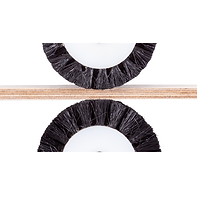
Loose particles are removed from the flooring core before adhesive application.
02
Apply the Controlled Adhesive Layer
The glue spreading machine applies the specified adhesive quantity evenly across the prepared core under digitally controlled spreading conditions.

The DGS 300 applies the specified adhesive quantity under digitally controlled spreading conditions.
03
Transfer the Glued Core
The integrated conveyor moves the glued flooring core from the application area to the press working area for layer assembly and stack preparation.

The integrated conveyor transfers the glued core to the assembly and pressing area.
04
Assemble and Form the Stacks
In the standard configuration, operators position the hardwood wear layer on the glued core and form the assembled flooring elements into stacks for pressing.

The core and hardwood wear layer are assembled and formed into a stack for pressing.
05
Press Under Defined Conditions
The prepared stack is positioned in the digital flooring press, where the specified pressure and pressing time are applied according to the product construction and adhesive process.

The prepared stack is pressed under the defined pressure and time conditions.
06
Release and Unload
After the defined pressing cycle is complete, the stack is released and unloaded for transfer to the next production stage.

After the pressing cycle, the laminated stack is released for transfer to the next production stage.
The essential process logic remains the same across different configurations, while the selected material-handling and automation scope determines which transfer, assembly, stack-forming and unloading activities are performed automatically.
Three Functional Building Blocks of the System
A complete cold lamination system can combine controlled hydraulic pressing, digital adhesive application and material handling around one coordinated production workflow. Each building block has a distinct role, while the final configuration depends on the flooring formats, adhesive process, operating rhythm and required level of automation.

PRESSING
Digital Flooring Press
The press applies and monitors the defined hydraulic pressure and pressing time while supporting accurate stack positioning across the selected working zones. Model and working-length selection depend on the flooring formats, construction and required production rhythm.

ADHESIVE APPLICATION
DGS 300 Digital Glue Spreading Machine
The DGS 300 removes loose particles from the flooring core, applies the specified adhesive quantity, and transfers the glued material toward the press. Digital setup coordinates spreading conditions with the board dimensions and application requirements.

MATERIAL FLOW AND AUTOMATION
Cold Lamination Automation
Material-handling modules can support feeding, transfer, layer assembly, stack preparation and outfeed according to the required scope. The configuration should reflect actual operator roles, available space, product mix and target output.
Designed to Work as One Coordinated System
The press, glue spreader, and material-handling modules are configured around the same board formats, adhesive process, and production rhythm. Standalone machines can be integrated into an existing workflow, while additional handling should be introduced where it solves a defined bottleneck or supports a justified expansion path.
Choosing the Right Cold Lamination Configuration
The most suitable configuration is not automatically the largest or most automated one. It should be based on the existing production environment, flooring formats, adhesive process, operator workflow, available space and the output the system must achieve under real operating conditions.
01
EXISTING-LINE INTEGRATION
Standalone Machine Configuration
A Digital Flooring Press or Digital Glue Spreader can be introduced independently where compatible machinery, material handling and process control already exist. The surrounding workflow should be technically reviewed rather than assuming that a new machine will operate efficiently in isolation.
Relevant when: replacing one production stage, increasing available capacity or extending an established cold lamination workflow.
02
COORDINATED STANDARD SYSTEM
Integrated Operator-Assisted System
The standard integrated configuration combines a Digital Flooring Press and DGS 300 around a coordinated material-transfer and operator-assisted workflow. One glue spreader can operate across both sides of a standard two-sided press through the integrated rail arrangement.
Operators position the core and wear layer, form the stacks, and manage loading and unloading, while adhesive application and pressing parameters are digitally controlled within their respective machines.
Relevant when: a complete cold lamination process is required without introducing wider automatic feeding, stack-forming, or outfeed systems.
03
EXPANDED MATERIAL FLOW
Expanded Material Handling and Automation
Conveyors, automatic feeding, gantry handling, layer assembly support, stack preparation, and outfeed can be added where they solve a defined production or material-flow requirement. The final architecture depends on the board formats, operator roles, available space, and required production rhythm.
Automation changes where operators engage with the process, but it should not be presented as automatically operator-free. Material preparation, supervision, forklift handling, unloading, cleaning, and maintenance may remain part of the operating structure.
Relevant when: manual handling, station-by-station tuning, production ergonomics, material transfer, or stack preparation creates a measurable constraint in the required workflow.
One or Two Glue Spreaders?
A second glue spreader is useful only when the press sides, board formats and operating workflow allow both sides to be supplied independently. It should be selected from a production calculation rather than from a general assumption that two spreaders always double output.

One spreader can serve both press sides, while two spreaders support simultaneous independent operation where the product format and workflow justify it.
One Glue Spreader
The DGS 300 moves across the integrated rail arrangement to serve both sides of the standard two-sided press. This can be sufficient when glue application, stack assembly and pressing cycles allow the spreader to alternate between the two working sides without restricting the required output.
Primary advantage: lower initial complexity while retaining access to both press sides.
Two Glue Spreaders
Two DGS 300 machines support simultaneous and independent adhesive application on both press sides. This may improve utilisation when board length, stack arrangement, staffing, or automation allows both sides to be loaded in parallel.
The benefit is format-dependent and does not mean that practical capacity will double for every product dimension.
Primary advantage: parallel supply to both press sides, where the complete workflow can use it.
The final configuration should be calculated from the principal board dimensions, product mix, adhesive and pressing time, stack arrangement, operator workflow and existing equipment—not from the number of machines alone.
What Determines Practical Cold Lamination Capacity
Practical cold lamination capacity is the output achieved by the complete workflow under defined operating conditions. It cannot be determined from the press model alone because board format, stack utilisation, adhesive process, material handling, and effective operating time interact throughout every production cycle.
01
Board Length and Width
Board dimensions determine how the available press length and working zones can be used, how many stacks fit within a cycle, and whether both press sides can operate efficiently.
02
Product Construction and Thickness
Core thickness, wear-layer thickness, and the overall laminated construction influence the number of elements within each stack and the total surface area produced per cycle.
03
Adhesive and Pressing Time
The adhesive system defines the required application conditions and pressing time. A longer pressing cycle reduces the number of complete production cycles available within a shift.
04
Press Size and Pressing Zone Utilisation
A longer press provides more usable working length only when the selected board formats and stack arrangement can use that length effectively. A larger model does not automatically increase output for every product.
05
Stack Arrangement and Product Mix
Producing one repeated format differs from combining several lengths and widths during the same shift. Independent pressing zones allow different stack arrangements, but each production programme requires its own calculation.
06
One or Two Glue Spreaders
Two spreaders can supply both press sides independently, but the benefit depends on board length, stack formation and whether the wider workflow can load both sides in parallel.
07
Operators and Automation Scope
Loading, layer assembly, stack formation, unloading and material supply must remain coordinated with the machine cycle. Automation may improve flow where handling is the constraint, but its effect depends on the complete architecture.
08
Effective Production Time
Material preparation, machine cleaning, format changes, planned interruptions and daily operating discipline reduce the time available for continuous lamination within a nominal shift.
Capacity Is a Workflow Result
The machine creates available production potential. Practical output depends on how effectively the complete workflow converts that potential into finished laminated elements.
A Larger Press Is Not Always Faster
Additional pressing length increases output only when the board dimensions and stack arrangement can use the added working space during each cycle.
Two Spreaders Do Not Always Double Output
Parallel adhesive application improves capacity only when both press sides, the selected board format, and the loading workflow can operate simultaneously.
Automation Must Address the Actual Constraint
Additional handling improves practical output when material transfer or stack preparation limits the process. It cannot compensate for an unrelated bottleneck elsewhere in the workflow.
Capacity should therefore be calculated from the planned production programme - not selected from one general output figure.
Information Needed to Select a Cold Lamination System
A technically useful recommendation begins with the planned production programme rather than a preferred machine model. The information below allows Deck Art Machines to compare suitable configurations and calculate capacity around the actual product range, workflow and operating conditions.
Project Information Checklist
Exact values are helpful where available, and estimated ranges are sufficient for an initial technical review as well.
01
Flooring Construction and Materials
State whether the product uses a two-layer or three-layer construction and identify the core, hardwood wear layer, and any backing material. Include significant material variation or current bonding issues that the process must address.
02
Board Dimensions and Product Mix
Provide the minimum and maximum board lengths, widths, and total thickness, together with the principal recurring formats. Also identify whether production is dominated by one format or involves frequent changes between several products.
03
Adhesive and Pressing Process
Identify the adhesive type and supplier, required application quantity, pressing time, and pressure, where these values are already defined. Where they are not known, provide the process currently used or the adhesive system being considered.
04
Target Output and Shift Pattern
State the required output under a defined shift basis, the expected number of shifts, and the product mix behind that target. Separate current demand from possible future growth so the initial requirement is not overstated.
05
Existing Equipment, Operators and Bottlenecks
Describe the existing press, glue application, conveyors, and material-handling equipment, together with the number and roles of available operators. Identify where delays, excessive handling, or quality problems currently occur.
06
Factory Space, Material Flow and Expansion
Provide the available production area, access routes, material entry and exit directions, forklift requirements, and any fixed surrounding equipment. Indicate the desired initial automation scope and any realistic later expansion objectives.
A Useful Starting Brief Does Not Need to Be Complete
Useful Material to Share
Main lengths, widths, thicknesses, and expected production share.
A short description, photographs or video of the existing workflow.
A floor plan or dimensioned sketch showing access and material-flow direction.
Existing production records and the future requirement under a stated shift basis.
What the Initial Review Can Establish
Whether the requirement points toward standalone machinery, an integrated standard system, or wider automation.
Projected output under clearly stated board, process, staffing, and shift assumptions.
The information, tests, or layout work still required before a final specification can be prepared.
Start with a Rational Configuration and Expand When Justified
Deck Art Machines recommends beginning with the simplest complete configuration that can meet the current production requirement under defined operating conditions. This limits unnecessary first-stage complexity, supports a controlled production start and preserves technically realistic options for later expansion.
01
Define the Present Requirement
Use the principal board formats, product mix, adhesive process, target output, available operators and factory space to establish the initial system scope.
02
Establish the Initial Process
Commission the selected configuration, prepare the operating team and establish repeatable routines for adhesive application, layer assembly, pressing and daily machine care.
03
Review Operating Evidence
Evaluate practical output, press utilisation, product changes, handling time, operator workload, bonding performance and recurring interruptions under actual production conditions.
04
Expand Around a Defined Need
Add equipment or automation only when it addresses a measured bottleneck, a justified output requirement or a planned change in product scope.
Expansion is an option, not an obligation. A system that meets the required production programme efficiently may remain in its initial configuration. Later additions should solve a verified production need rather than introduce complexity without a measurable purpose.
Possible Expansion Paths
Where the original architecture, factory space, and agreed project scope support it, later development may include the following elements.
A Second Glue Spreader
Supports independent adhesive application on both press sides where the board formats, staffing and production rhythm can use parallel operation.
Additional Preparation or Machinery
Adds a required upstream or downstream function where the existing process does not provide the necessary material condition or workflow capability.
Conveyors and Material Handling
Coordinates transfer between process stages and reduces unnecessary manual movement where handling has become a defined constraint.
Gantry and Pallet Systems
Automates selected feeding, layer-handling, stack-preparation or outfeed activities according to the approved system architecture.
Wider Production Integration
Connects cold lamination with a broader material-flow or factory-development plan where the production programme and available space justify it.
Implementation and Connected Support
Installation, commissioning, operator training, and production start-up support are defined according to the agreed machine configuration, destination, and project scope.
Where the system architecture and site connectivity allow, remote access can support diagnostics, troubleshooting, parameter review, process tuning and software updates during commissioning and later operation.
Continuing optimisation, custom software work or additional engineering is defined within the agreed support scope. It should not be interpreted as unlimited or permanently included development.
The objective is to establish a reliable initial process and use real operating evidence to guide the next decision.
Explore the Dedicated Technical Pages
Continue with the page that matches the technical decision you need to make next. Each page examines one part of the cold lamination system in greater depth.
PRESS DESIGN AND SELECTION
Cold Lamination Presses
Best next step for press architecture, model comparison, and detailed press selection.
Review the DCP press range, working dimensions, independently controlled pressing zones, self-aligning pressing plates, hydraulic systems, and model-specific selection factors.
ADHESIVE APPLICATION AND CONTROL
DGS 300 Digital Glue Spreading Machine
Best next step for adhesive control, machine setup and coordination with the press.
Explore glue-quantity and board-dimension inputs, roller-pressure control, adhesive supply, dedusting, cleaning and the DGS 300 operating relationship with the cold press.
MATERIAL HANDLING AND AUTOMATION
Cold Lamination Automation
Best next step for workflow scaling, material flow and operator-role planning.
Review feeding systems, conveyors, gantry handling, pallet flow, stack transfer, and possible project-specific automation paths for the complete lamination process.
Cold Lamination System Questions
These answers cover the questions most often raised when evaluating an engineered wood flooring cold lamination system. Final configuration and capacity still depend on the actual product, process and operating conditions.
What is cold lamination in engineered wood flooring production?
Cold lamination is the production stage in which a prepared flooring core receives a controlled adhesive layer, is assembled with a hardwood wear layer and is pressed under defined pressure and time conditions to form a bonded engineered flooring element. The result depends on the coordinated process, not on the press alone.
Can the press and glue spreader operate as standalone machines?
Yes, where the surrounding machinery, controls and material-handling workflow are technically compatible. The standard integrated configuration coordinates adhesive application, transfer and pressing, but either machine may be evaluated separately when an existing production setup can perform the remaining process stages correctly.
When is a second glue spreader useful?
A second glue spreader can be useful when both sides of a two-sided press require parallel, independent material supply and the product formats, cycle timing, staffing and handling workflow can use the additional flow. It does not automatically double practical output because another part of the process may remain the limiting factor.
What determines the practical capacity of a cold lamination system?
Practical capacity is the output achieved by the complete workflow under defined operating conditions. It depends on board dimensions and construction, adhesive and pressing time, press-zone utilisation, stack arrangement, product mix, glue-spreader configuration, operators, material handling, cleaning, and the effective production time available.
Can an initial system be automated later?
In many projects, yes—provided a realistic expansion path is considered in the initial system architecture, layout and agreed scope. Later additions may include a second glue spreader, conveyors, gantry handling, pallet systems, or outfeed handling. Compatibility, available space, and the actual production constraint must be reviewed before each expansion.
What production information is needed to configure a system?
A useful starting brief includes the flooring construction and materials, principal board formats, product mix, adhesive and pressing process, target output and shift pattern, available operators, existing equipment, current bottlenecks, factory space, material flow and future expansion priorities. Preliminary ranges are acceptable when the assumptions are clearly stated.
COLD LAMINATION PROJECT ENQUIRY
Discuss Your Cold Lamination Requirements
Share the information currently available about your product, process and production objective. Deck Art Machines can use it to assess the most relevant starting configuration, identify the assumptions that still require confirmation and determine the next technical step.
You do not need a completed specification. Preliminary formats, target ranges, photographs, video or an available-area drawing can provide a useful basis for the first review.
What the initial review can establish
-
A relevant standalone, integrated or automation direction
-
The technical information and assumptions still requiring confirmation
-
A basis for the next capacity, layout or configuration discussion
Cold Lamination Project Information
Complete the fields you can answer at this stage. Fields marked “*” must be completed before submission.